English
 Español
 عربى
Home / News / Industry News / What Is Seamless Joint Holographic Cardstock and Why It Matters for Big Boxes?
Industry News


Content
Holographic cardstock is a reliable way to make packaging feel special. The shifting rainbow effect immediately signals premium quality and draws attention on retail shelves. But when the package is a large box, the pattern has a habit of revealing its own construction: a visible seam or joint where the holographic design repeats. That is exactly the problem that seamless (seamless joint) holographic cardstock solves.
This guide explains what seamless joint holographic cardstock is, how it differs from standard holographic materials, and why it is a critical choice for big box packaging.
Seamless joint holographic cardstock is a holographic packaging paper engineered so that its iridescent pattern appears as a continuous image across the entire sheet surface. The "joint" refers to the area in conventionally manufactured holographic cardstock where the embossing pattern ends and restarts, producing a visible seam. In seamless construction, that joint is eliminated or hidden within the design logic of the pattern.
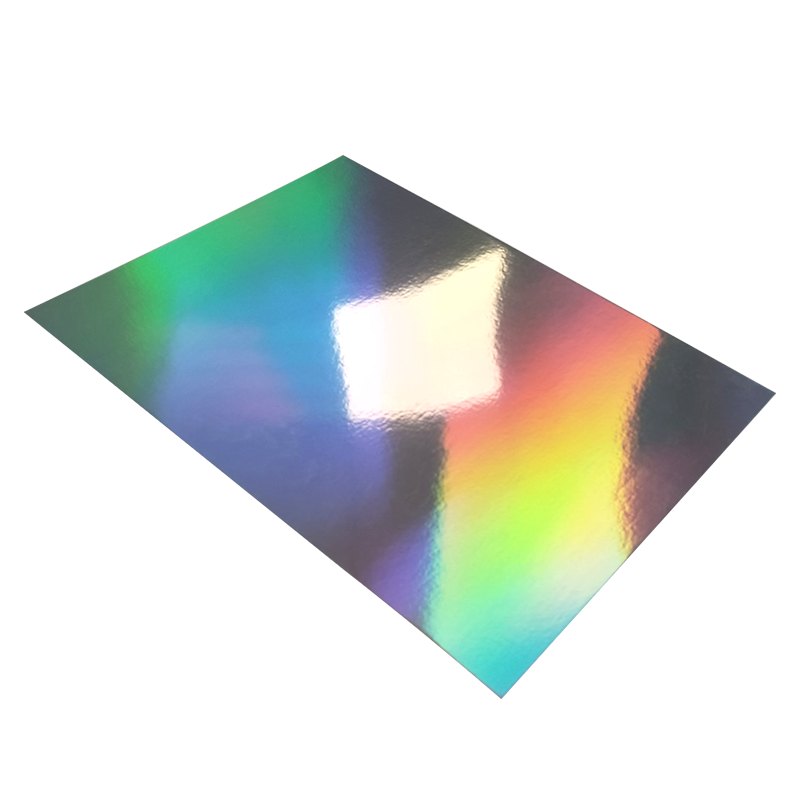 Solid Holographic Cardstock for Seamless Holographic PackagingThis PET-based cardstock offers a smooth, uniformly embossed holographic surface with stable dimensional properties, making it a strong base for the seamless holographic packaging discussed here, where pattern continuity across folds and edges matters.View Product →
Standard holographic cardstock is produced by embossing a repeating micro-structure onto a metallized layer. Because the embossing tool is a cylinder with a fixed circumference, the pattern repeats at a fixed interval. When that interval falls short of the packaging dimension, the repeat line shows up as a sharp discontinuity on the box. Seamless holographic cardstock is manufactured with the repeat size and box dimensions in mind, so the motif flows naturally from one edge to the other, including across score lines and folds.
For packaging developers, the practical meaning is simple: what you design is what you see. There is no unpredictable stripe, no hard pattern reset in the middle of a box panel, and no need to hide seams behind structural elements.
The manufacturing process starts with a base paper, typically ranging from 30 to 450 gsm depending on the final box structure. The paper receives a coating to create a smooth, uniform surface, followed by a vacuum metallization step that deposits a thin metallic layer. A laser-engraved embossing cylinder then transfers the holographic micro-structure onto the metallized surface, and a protective coating is applied to support printing and lamination.
In seamless holographic cardstock, the critical step is the design and engraving of the embossing cylinder. Instead of a small repeating tile, the pattern is engineered to match a defined repeat width that suits large format packaging. The motif can be a solid holographic effect or a directional effect such as linear holographic cardstock, where parallel lines create a brushed, flowing movement across the surface.
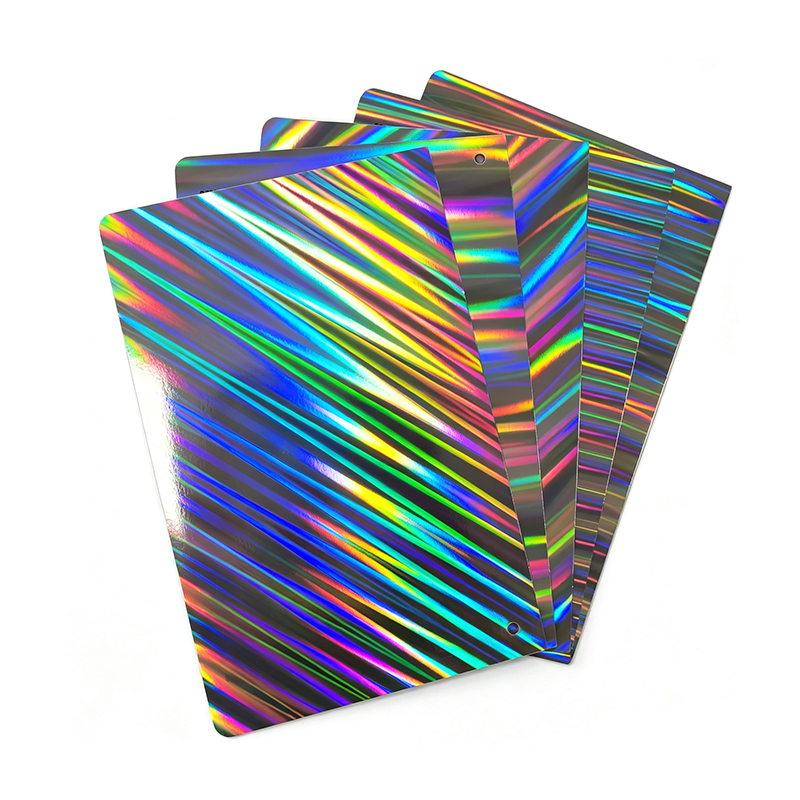 Linear Holographic Cardstock with Directional Columnar EffectsFeaturing precision-embossed parallel lines that create a brushed, flowing movement, this cardstock aligns with the seamless construction concept above, as its linear pattern can be engineered to match large-format packaging repeats without visible seams.View Product →
The result is a material where the holographic effect behaves like a printed graphic rather than a tiled texture. This allows designers to treat the hologram as part of the artwork, aligning it with panels, folds, and window cutouts instead of working around a fixed repeat.
Big boxes present a unique challenge. The larger the surface, the more visible any pattern defect becomes. A seam that is barely noticeable on a small cosmetic carton can run across the full width of a gift box lid or a wine carrier, making the packaging feel cheap and inconsistent.
On a large folding carton, a visible holographic seam does not look like a design choice. It looks like a printing error. Seamless holographic cardstock removes that risk entirely.
Beyond seam visibility, seamless patterns support the structure of big boxes in three ways:
The comparison below summarizes why seamless construction wins for large format packaging:
| Attribute | Standard Holographic | Seamless Holographic |
|---|---|---|
| Pattern continuity | Repeating tile | Continuous image |
| Seam lines on large panels | Often visible | Eliminated or designed in |
| Fold and score behavior | Pattern shifts | Flow is preserved |
| Premium perception | Moderate | High |
| Suitability for big boxes | Requires layout care | Built for large surfaces |
Seamless holographic cardstock is not only a visual upgrade; it also performs well in production. Because the coating is designed for ink adhesion, the material works with a wide range of processes including UV offset printing, silk screen printing, and gravure printing. This makes it possible to add spot colors, white ink, or variable data on top of the hologram without losing quality.
For converters, the material's stable layer structure means clean die-cutting, scoring, and creasing. There is no flaking or delamination at the seam area, primarily because there is no seam. Lamination and foil stamping also behave consistently across the sheet, which reduces waste and press adjustments.
From a production planning perspective, seamless holographic cardstock eliminates the need to orient every blank in a specific direction to hide a pattern repeat. That simplifies cutting layouts and improves material utilization, an important factor for large carton runs.
When selecting seamless holographic cardstock for big boxes, evaluate the following specifications:
Requesting samples and proofing with the actual print process is recommended, because the interaction between holographic effect, coating, and ink changes from one specification to another.
Seamless holographic cardstock is used wherever packaging needs to communicate value at the moment of purchase. The cosmetics industry is one of the largest adopters, especially for gift sets, serum boxes, and limited edition packaging where a flawless holographic finish supports a premium brand image. Wine and spirit packaging also benefits from seamless holographic materials on large gift boxes and multi-bottle carriers.
For an overview of how holographic materials are applied in beauty and personal care, our cosmetics packaging applications page discusses material selection, printing, and structural considerations in detail.
 Customized Holographic Paper for Brand-Specific PackagingBuilt on high-grammage substrates with customizable holographic textures, patterns, or logos, this material supports printing and finishing processes, making it suitable for the cosmetics and other premium retail packaging applications mentioned in the surrounding text.View Product →
Beyond cosmetics and wine, the material appears in tea packaging, premium confectionery, electronics accessories, and any retail category where the outer box does more than protect the product. The ability to customize the pattern means a brand can create a distinctive surface texture that cannot be duplicated with standard off-the-shelf holographic cardstock.
Regular holographic cardstock contains a repeating pattern that creates a visible joint or seam at the pattern boundary. Seamless holographic cardstock is engineered so the pattern continues across the sheet without a visible boundary, making it suitable for large panels and big boxes.
Yes. Seamless holographic cardstock is compatible with UV offset printing, silk screen printing, and gravure printing. Its coating is formulated to accept ink and provide good rub resistance after finishing.
Yes. In fact, it is the preferred choice for big boxes because it prevents visible pattern seams on large panels and fold lines. Base paper weights up to 450 gsm provide the rigidity needed for robust box structures.
Custom patterns can be developed to match brand identity, including linear directions, embedded motifs, and specific repeat sizes. This requires close cooperation with the material supplier to align the embossing design with the packaging layout.
Seamless joint holographic cardstock solves a problem that many packaging teams do not realize they have until the first large-format prototype is printed. By eliminating the visible seam, the material lets the holographic effect perform the way it was intended: as a continuous, immersive surface that makes a big box feel intentional and premium.
For a deeper look at how holographic cardstock behaves across different applications, our multidimensional exploration of holographic cardstock covers patterning, printing, and structural considerations in more detail.